
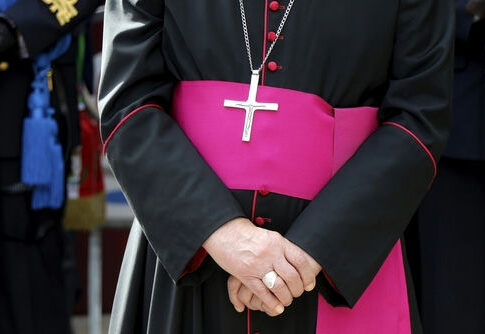
Bishop Athanasius Schneider claims that the deepest crisis in centuries has gripped the Catholic Church—and that the fingerprints of Freemasonry are all over it.
Story Snapshot
- Schneider describes a global crisis of doctrine, morals, liturgy, and spiritual life inside the Church, not at its edges.[5][6]
- He argues that relativism and naturalism, visible since the Council, hollowed out truth from within.[6]
- He links this crisis to a long “infiltration” by Freemasonry and a man‑centered worldview hostile to Christ.[5]
- Critics say he offers suspicion and patterns, not hard documentary proof of Masonic control.[2][4]
How Schneider Frames A Crisis No One Can Ignore
Bishop Schneider does not speak as a detached academic; he speaks as a man who believes the house is already on fire. He describes an “extraordinary grave crisis in the Church” as something permitted by Divine Providence, but humanly beyond ordinary solutions.[3] In one striking passage he says that “only divine intervention can help,” even through persecution of the Church and the pope by anti‑Christian global elites, a severity that tells you how desperate he thinks the situation has become.[1]
When Schneider lists the symptoms, the picture turns darker. He speaks of open propagation of heresies, legitimization of homosexual behavior, religious indifferentism, sacrilege, and apostasy, promoted “with impunity” even by bishops and cardinals.[1][8] He insists this is not a localized flare‑up but a “huge confusion” that is “almost global,” touching doctrine, moral teaching, liturgy, and spiritual life.[5] For many conservative Catholics who feel whiplash from constant change and moral compromise, his diagnosis names what they already sense.
Relativism, Naturalism, And The Roots He Sees Under The Floorboards
Schneider does not stop at listing scandals; he tries to trace the wiring. He identifies relativism—a crisis of truth itself—as the deepest root of the present turmoil. In a long interview he argues that relativism “crept in, infiltrated the life of the Church” and became visible after the Second Vatican Council, including through ambiguous statements that could be read in several ways.[6] If truth can shift with fashion or culture, then doctrine, morality, and liturgy all become negotiable, which is exactly what he believes has happened.
Alongside relativism he points to a new “naturalism,” a habit of putting temporal issues—climate, migration, politics—above the eternal destiny of the soul.[6] He calls this a kind of “Pelagianization” of the Church, where human projects and activism replace grace and conversion as the center of Christian life. For readers steeped in American conservative instincts, that diagnosis rings familiar: when elites talk endlessly about policy and rarely about sin, judgment, or salvation, something essential has already been traded away.
Freemasonry As The Invisible Architect Of Decline
This is where Schneider takes a step that many others do not. He explicitly links the crisis to the “infiltration” of the Church by an unbelieving world, “especially by Freemasons.”[2] He describes Freemasonry as an “instrument of Satan,” intrinsically incompatible with Christian faith, with esoteric rituals and symbols that form “another religion.” At the heart of that religion, he claims, stands the worship of man alone, “avoiding Christ at any cost and eliminating Christ.”[5]
For Schneider, this is not mere metaphor. He points to historical Masonic texts such as the so‑called Permanent Instruction of the Alta Vendita, which allegedly sketched a long‑term plan to infiltrate the Church, soften doctrine, and eventually produce “a pope according to our heart.”[2][3] He adds that “some bishops and cardinals speak clearly with a Masonic spirit,” using language of relativism and human‑centered religion, even if no lodge card can be produced. His core claim is that the Masonic worldview, not just its membership, has colonized much of Catholic leadership.
Proof, Suspicion, And The Limits Of The Infiltration Thesis
The moment the word “infiltration” appears, sober minds want receipts, not just rhetoric. Here the record becomes thin. None of the material tied to Schneider names a specific bishop, cardinal, or Vatican official whose documented Masonic membership can be independently verified.[2][5][6] The available evidence is primarily his own interviews, forewords, and talks, amplified by sympathetic outlets. That is enough to show what he believes, but not enough to demonstrate an operational network directing Church policy.
Serious Catholic commentators sympathetic to tradition acknowledge this gap. A detailed critique of his catechetical book “Credo” praises his courage but faults him at times for oversimplification and reactive framing.[4] From a common‑sense conservative standpoint, it is one thing to say that secular, man‑centered ideas have penetrated the Church; that much is obvious on any Sunday bulletin. It is another to assert that Freemasonry, as a concrete organization, sits behind every ambiguous paragraph or disastrous policy without documentary chains, sworn testimony, or access to internal lodge records.
Why His Warning Still Resonates With Ordinary Believers
Yet even critics struggle to dismiss him entirely, because the crisis he describes is not imaginary. The normalization of previously unthinkable positions, the sidelining of faithful priests, the liturgical wars, the silence in the face of blatant heresy—these are visible to anyone paying attention.[1][3][5][6][8] Schneider argues that God permits this as a severe purification, forcing Catholics to cling to the perennial faith rather than personalities or structures.[3] That message, far from breeding despair, offers many lay people a blueprint for survival.
American conservatives, especially those who have watched institutions captured from within, recognize the pattern he sketches: small compromises, bureaucratic language, and elite networks gradually rewire an organization without open admission of a coup. Whether or not Freemasonry is the central puppet master, the practical takeaway aligns with basic conservative instincts: recover clarity of doctrine, restore reverent worship, reject relativism, and stop pretending that endless “dialogue” will rescue a Church that has forgotten what it is for.
Sources:
[1] Web – Bishop Schneider: ‘Only divine intervention can help’ Church crisis …
[2] Web – The Long Infiltration of the Catholic Church – Crisis Magazine
[3] Web – Bishop Schneider Offers Hope Amidst Crisis Permitted by “Divine …
[4] Web – The weaknesses and flaws in Bishop Schneider’s Credo
[5] Web – Flee From Heresy: Bishop Athanasius Schneider – GloriaDei.io
[6] YouTube – The Church Crisis No One’s Talking About, and How We …
[8] Web – Interview with Bishop Athanasius Schneider | PDF | Catholic Church