
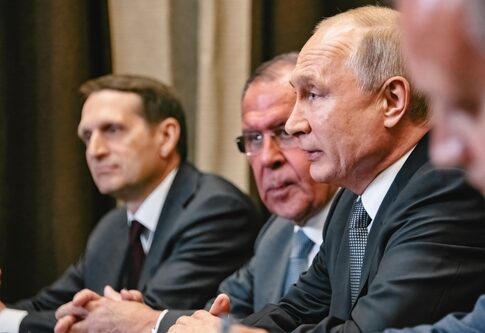
An anonymous investor just placed a $370,000 bet that Vladimir Putin will be out of power before the end of 2026 — and the timing has people asking whether someone knows something the rest of us don’t.
Story Snapshot
- An unknown bettor wagered $370,000 on Polymarket that Putin will leave power by December 31, 2026.
- The broader Polymarket crowd puts the odds at only about 9–14% — meaning most bettors think Putin stays.
- The bet follows a pattern of large, anonymous wagers on political events that have raised serious insider trading concerns.
- Nine linked accounts previously made $2.4 million betting on U.S. military actions in Iran with a 98% win rate.
A $370,000 Bet That Raised Eyebrows
Someone dropped $370,000 on Polymarket — a crypto-based prediction market — betting that Russian President Vladimir Putin will no longer be in power by December 31, 2026. The bettor’s identity is completely unknown. No name, no track record, no public explanation. That kind of money on a long-shot bet naturally gets people talking. The overall market crowd disagrees sharply, placing the odds of Putin’s removal at just 9–14%. That means roughly 86–91% of bettors think he stays put.
To put the bet in context, this is not a small speculative flutter. A $370,000 wager on a roughly 10% probability event is a serious financial commitment. Either the bettor has money to burn, or they believe they know something. That second possibility is exactly what’s making people nervous — because it has happened before on this same platform.
Prediction Markets and the Insider Trading Problem
Polymarket has been at the center of several alarming insider trading cases. Just before the U.S. removed Venezuelan President Nicolás Maduro from power in early January 2026, an anonymous trader bet $30,000 on his ouster and walked away with more than $436,000 in profit. In another case, nine linked anonymous accounts made $2.4 million betting on the specific dates of U.S. military actions in Iran — including the first strikes and a ceasefire announcement — with a jaw-dropping 98% win rate. A New York Times investigation found over 80 suspicious users on the platform.
These cases have prompted real concern in Washington. Experts warn that government workers, military officials, and others with access to classified information can still legally bet on these markets. The Senate has moved to ban its own members from trading on prediction markets, but House members, executive branch employees, and military personnel face no such restriction. Congress has been urged to close that loophole fast — because the opportunity for corrupt profit from insider knowledge is wide open.
What Is Actually Happening Inside Russia?
Several reports point to growing pressure on Putin. Russia’s stock market dropped nearly 5% in a single day in June 2026 — its largest single-day fall in three years. A Russian former military officer named Alexander Lunan publicly called on troops to turn weapons against the Kremlin, though he later distanced himself from any rebellion. Kremlin spokesperson Dmitri Peskov dismissed Lunan’s appeal as unreviewed. Lunan was then detained for 11 days and his home was searched — a clear sign the Russian state took the threat seriously enough to act.
An unknown investor has bet $370,000 that Putin will step down as President of the Russian Federation by the end of 2026.
The bet was placed on the prediction platform Polymarket.Trump? pic.twitter.com/La8hmYbsPw
— Jürgen Nauditt 🇩🇪🇺🇦 (@jurgen_nauditt) July 1, 2026
None of the bigger claims — a military mutiny, a financial collapse, or a crossed nuclear red line — have been confirmed by U.S., British, or Russian official sources. The videos driving much of this narrative come from YouTube channels, not verified intelligence reports. The market crowd reflects that uncertainty: they give Putin a roughly 90% chance of staying in power. The $370,000 bet stands alone against that consensus. Whether it reflects bold speculation or something more troubling is the question no one can answer yet.
Why This Matters Beyond Russia
The bigger story here is not just about Putin. It is about whether anonymous bettors with possible access to government secrets are using prediction markets as a personal ATM. American taxpayers deserve to know that their military and intelligence officials are not trading on classified information for personal gain. The pattern of suspiciously well-timed bets — on Iran, on Venezuela, and now possibly on Russia — demands accountability. Congress needs to act, and the public needs to pay attention.
Sources:
mediaite.com, oddschecker.com, bbc.com, chinatalk.media, nytimes.com