
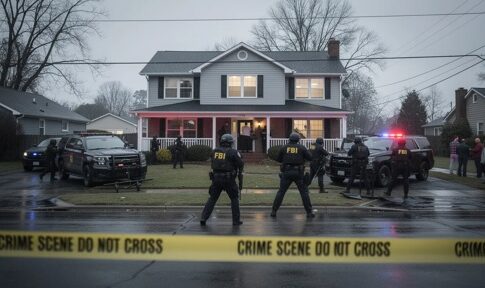
Someone picked up a phone, lied about gunfire at Justice Amy Coney Barrett’s home, and turned America’s highest court into a potential crime scene without ever pulling a trigger.
Story Snapshot
- A false report of “shots fired” sent armed officers racing to Justice Barrett’s Virginia home.
- Police quickly flagged it as likely swatting, but only after the risk was already created.
- Swatting is framed as a hoax, yet functions like a remote-control violent threat.
- Targeting Supreme Court justices this way undermines both safety and constitutional order.
Swatting a Supreme Court Justice Turns Politics Into a Kill Box
Police in Fairfax County, Virginia received a report of shots fired outside the home of Supreme Court Justice Amy Coney Barrett on a Wednesday night, and that single lie immediately mobilized an armed response to her residence.[1] Officers rushed to the address and coordinated with the Supreme Court security detail already posted there to protect a sitting justice of the United States.[1] Every responding cruiser, every drawn weapon, and every unknown shadow on that street became a potential flashpoint.
Fairfax County Police later told reporters they “responded to a swatting call” and “quickly determined that the report was fictitious,” after speaking with Barrett’s security and finding no evidence of gunfire.[1] Dispatch audio shared online shows that even as officers rolled, dispatchers warned it might be a swatting situation because they could not reach the original caller.[1] That suspicion did not erase the danger; it merely meant officers were bracing for both an ambush and a hoax at the same time.
REPORT ~ DETAILS: Swatting Incident Thwarted as Police Respond to Reports of Gunshots Fired Near Home of Amy Coney Barrett in Latest Assassination Attempt Against Conservative Justice
Police late Wednesday night responded to a call for ‘suspicious noise’ thought to be gunshots… pic.twitter.com/o4fHmtxikF
— Sergeant News Network (@sgtnewsnetwork) May 28, 2026
Why A “Hoax Call” Operates Like A Weapon
Swatting is the practice of falsely reporting a violent emergency to trigger an armed police response to someone’s address, and it has increasingly targeted public officials, judges, and other high-profile figures.[1] The tactic weaponizes law enforcement protocols by forcing officers into a high-alert posture based on manufactured facts. The caller does not need a gun; the caller only needs a convincing story that compels police to arrive ready to confront lethal force that does not exist, surrounded by people who very much do.
At Barrett’s home, the practical result was that heavily armed officers converged on the residence of a Supreme Court justice, her family, and the security detail tasked with keeping them alive.[1] That convergence is not a prank; it is a deliberately engineered moment of maximum risk, where a misunderstood gesture, a glint of metal, or a garbled command can end with body bags. From a common-sense conservative view, intent matters, but foreseeable consequences matter more. The foreseeable consequence here is that someone could be shot because a stranger decided to play games with the 911 system.
From Online Harassment To Assault By Proxy
Law enforcement and media often describe swatting as a hoax, but the effect aligns much more closely with assault by proxy. The caller uses the state’s monopoly on legitimate force as a tool, aiming it at a political enemy, an ideological target, or simply someone they want to intimidate.[1][3] In Barrett’s case, the target is not random. She is an associate justice whose votes shaped decisions on abortion, religious liberty, and administrative power, making her a focal point of modern cultural conflict.
Swatting Incident Thwarted as Police Respond to Reports of Gunshots Fired Near Home of Amy Coney Barrett in Latest Assassination Attempt Against Conservative Justice https://t.co/fEFju2btdL #gatewaypundit via @gatewaypundit
— Lady Lisa 🇺🇸 🇮🇱 🇮🇷 (@littleladysage2) May 28, 2026
Critics online immediately framed the incident as another assassination attempt in everything but name, reflecting a widespread sense on the right that conservative justices are under siege. That language may outrun the currently available facts, because there is no public evidence that the caller coordinated with anyone on the ground or intended a confirmed kill. Yet the instinct behind that reaction is not hysterical; it recognizes that if you repeatedly send armed officers into tense, manufactured emergencies, probability alone will eventually do the killer’s work.
Why Normalizing Swatting Erodes Constitutional Order
When the target is a Supreme Court justice, the stakes extend beyond personal safety and into constitutional stability. The Court only functions if justices can interpret the law without fearing that a controversial opinion will bring armed chaos to their front door. Swatting injects the threat of sudden violence into that calculation without leaving fingerprints that look like traditional political violence. That subtlety makes it attractive to extremists who want intimidation without martyr stories.
An apparent “swatting” incident targeted the residence of Supreme Court Justice Amy Coney Barrett on Wednesday night, police confirm to NBC News. https://t.co/Vx5IxbpgPm
— NBC News (@NBCNews) May 28, 2026
Authorities publicly labeled the Barrett incident a fictitious report and cleared the scene, but treating it only as a false alarm misses the bigger pattern.[1] Each unpunished swatting normalizes the idea that you can outsource muscle to the state by lying convincingly enough. For a society that claims to respect the rule of law, that is a dangerous double standard. If someone called in fake gunfire at a member of Congress or a federal judge in a criminal trial, most Americans would see it as a serious threat, not adolescent mischief.
Sources:
[1] Web – Swatting Justice Barrett Was a Threat, Not a Prank
[3] Web – Police Respond to ‘Swatting’ Attempt at Justice Amy Coney Barrett’s …