
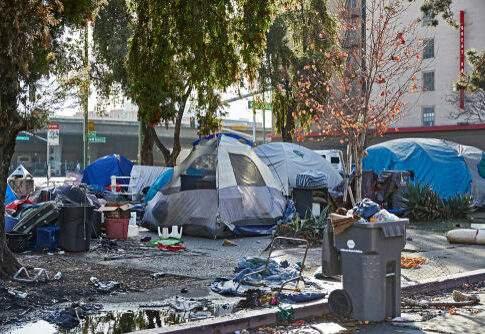
A socialist Los Angeles politician who built her brand on radical homelessness compassion just melted down the moment “homelessness” showed up on her own front lawn.
Story Snapshot
- A fake homeless encampment was staged outside mayoral candidate Nithya Raman’s home as a pointed critique of her homelessness record.
- The masked organizer called it political satire and a “parody ad” exposing what residents live with in her district.
- Raman condemned it as violating her family’s personal space and invoked her young children’s safety.[2]
- The clash spotlights a larger question: if you campaign on transforming homelessness policy, where should voters hold you accountable—only at ribbon cuttings, or also at your own doorstep?
When Homelessness Politics Arrive in the Driveway
Los Angeles City Councilmember Nithya Raman built her rise on sweeping promises to reshape the city’s approach to homelessness, then parlayed that into a campaign for mayor built on the same theme.[1][2] Her own official materials describe her as leading efforts to overhaul the city’s response as chair of the Housing and Homelessness Committee.[1] That is why the image of tents, trash, and makeshift encampment props outside her own house hit so hard: the symbol crashed straight into the story she has been selling voters.
The organizer behind the stunt appeared on camera wearing a mask, explaining that the setup was intended as political theater, not an actual encampment. He framed it explicitly as satire, saying they were “basically doing a parody ad for her,” the sort of campaign spot he would cut if he ran the opposition messaging. He tied the mock encampment to homelessness conditions across Raman’s District 4, arguing that residents live with this reality daily while their representative talks in lofty policy language.
Satire, Donors, and the Safe Cities Network
The masked organizer said the display was funded by donors from across the country associated with a group called Safe Cities USA, portraying it as an advocacy effort backed by people tired of permissive urban policies. He insisted he had no formal coordination with rival mayoral candidate Spencer Pratt’s campaign, though he expressed support for Pratt’s work, which matters because campaign coordination would turn a protest into potential election “dirty trick” territory. As things stand, viewers only have his word; no public records from Safe Cities USA confirm the expenditures.
That gray zone is familiar to anyone who has watched modern political guerrilla marketing. Donor networks and advocacy outfits float just outside campaign walls, funding “educational” stunts that look, walk, and quack like campaign attacks but technically sit one legal step removed. The lack of names, internal documents, or financial disclosures means voters must decide whether to treat his claims as legitimate advocacy or as a faceless hit job hiding behind a cause. Conservatives generally value transparency and accountability; anonymity undermines both.
Raman’s Response: Family, Fear, and the “Line” of Acceptable Politics
Raman’s campaign quickly blasted the stunt, saying it “crossed a line into personal space,” a clear attempt to shift the frame from policy critique to harassment.[2] Raman herself pointed to her children, saying she has “two little kids” and expressing relief they did not see the encampment that morning, before adding that the campaign had gone far beyond what she expected politics to entail.[2] That language invites voters to view her not as an official accountable for public conditions, but as a mother whose home was invaded.
There is a genuine dilemma here. America has seen a surge in targeted protests and intimidation at officials’ homes, and families should not be collateral damage in political warfare. At the same time, when a politician’s core promise is to transform streets overwhelmed by encampments, residents reasonably ask: if this setup is “over the line” at your house for thirty minutes, what does that say about months or years of similar conditions outside their homes, schools, and small businesses? That is the tension the stunt forced into the open.
Is This Exploitation or Accountability Theater?
Critics of the stunt argue it exploits the suffering of real homeless people by turning their reality into a prop for a quick viral moment. That charge lands hardest if the mock encampment bore little resemblance to what actually exists in District 4. Raman’s own homelessness materials emphasize structural reform, services, and humane outreach, language that often downplays the daily disorder residents experience.[1][2] If the staged scene exaggerated or caricatured real conditions, the satire risks becoming strawman theater rather than honest accountability.
Nithya Raman, she’s a LA City Councilmember running for mayor. A group staged a fake homeless encampment right outside her house in the hills of Silver Lake as political theater.
They set up props and actors in her driveway, filmed it to look chaotic, and pushed the videos… pic.twitter.com/JSPkXWdKsv
— Patricia 🇺🇸 (@1109Patricia) May 29, 2026
Supporters, however, will say the political class rarely listens when residents quietly complain through normal channels. They argue that only visual, uncomfortable spectacle cuts through sanitized talking points. From that perspective, taking the “lived experience” politicians routinely invoke and placing it where they actually live is not cruelty; it is symmetry. Conservative common sense generally sides with the principle that if a policy outcome is tolerable for the public, it should be tolerable for the official who champions it.
Beyond One Driveway: What This Says About LA’s Crisis Politics
Nithya Raman is not some back-bench councilmember; she is a central player in Los Angeles’ homelessness strategy and now wants the mayor’s office to expand that approach citywide.[1][2][3] Her debate exchanges with Mayor Karen Bass and Spencer Pratt already revolve around who has the more realistic plan to reduce encampments and restore order.[3] This driveway drama folds directly into that question: does her vision move the city toward fewer tents and less chaos, or does it normalize street camping as a permanent feature residents must simply endure?
For voters, the stunt becomes less about whether one masked organizer chose the perfect tactic and more about a basic threshold test. If an official cannot tolerate a symbolic taste of the policies and outcomes associated with her tenure, why should families and small businesses be expected to tolerate the real thing indefinitely? That is not cruelty; that is accountability. And as Los Angeles weighs another four years of its current trajectory, that may be the most important image to remember: a politician rattled by a brief performance of a crisis her own neighbors live with every day.
Sources:
[1] Web – Savage: One Advocacy Group’s Viral Campaign Delivers Homelessness to …
[2] Web – Homelessness | Los Angeles City Councilmember 4th District
[3] Web – Raman on homelessness – LAist